

Data Center Colocation Market Trends Point to USD 271.64 Billion Value with 12.89% CAGR by 2035
Data Center Colocation Market
Data Center Colocation Market is expanding rapidly, driven by cloud adoption, AI workloads, digital transformation, and rising enterprise data demands
Data center colocation is becoming a strategic foundation for modern businesses, enabling scalable infrastructure, enhanced connectivity, and reliable digital operations worldwide”
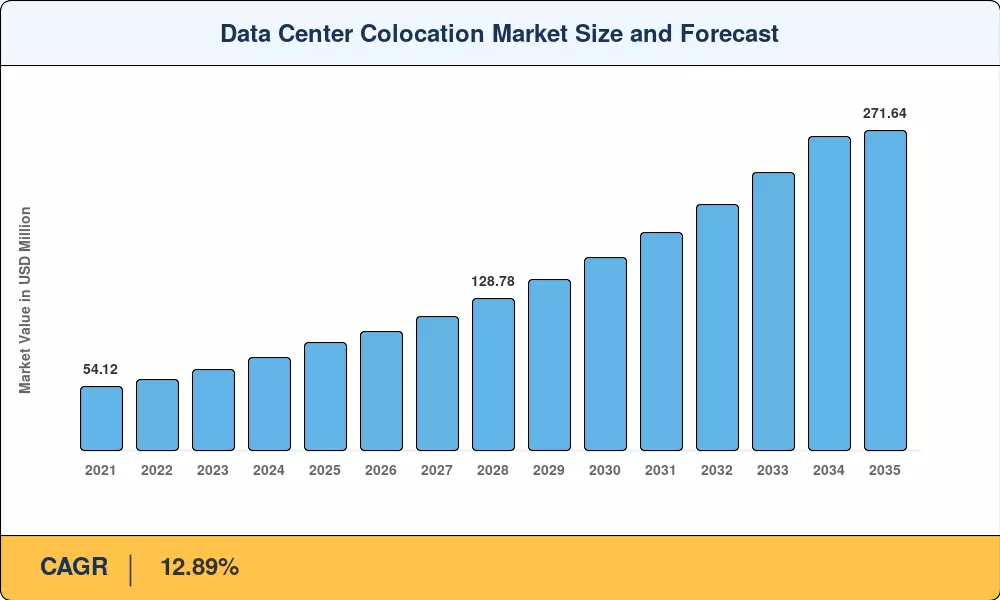
NEW YORK, NY, UNITED STATES, June 22, 2026 /EINPresswire.com/ -- The Data Center Colocation Market stood at an estimated USD 91.38 billion in 2025, with the forecast period launching from USD 101.04 billion in 2026 and climbing to USD 271.64 billion by 2035 at a CAGR of 12.89%. This remarkable growth trajectory reflects the accelerating digital transformation across industries, the explosion of AI workloads, and the strategic shift by enterprises toward hybrid and multi-cloud infrastructure models. Colocation services, where businesses lease space, power, cooling, and connectivity in third-party data centers, have evolved from a cost-saving alternative to a mission-critical component of modern IT strategy.— Market Research Future
The market's expansion is underpinned by the insatiable demand for data storage, processing power, and low-latency connectivity, driven by cloud computing, 5G rollout, IoT proliferation, and generative AI applications that require massive computational resources. As organizations seek to balance capital expenditure constraints with the need for scalable, secure, and compliant infrastructure, colocation providers are positioned as essential enablers of the digital economy. The forecast period through 2035 represents a transformative decade where colocation facilities will serve as the physical backbone for AI clusters, edge computing nodes, and sovereign cloud deployments worldwide.
Market Dynamics: Drivers, Restraints, and Opportunities
Drivers
The Data Center Colocation Market is propelled by several powerful forces. First, the exponential growth of data generation fueled by AI, big data analytics, IoT, and streaming services creates unprecedented demand for scalable infrastructure. Second, enterprises are aggressively adopting hybrid cloud strategies, requiring colocation facilities as neutral interconnection hubs that bridge private infrastructure with public cloud on ramps. Third, the AI revolution demands high-density computing environments with specialized power and cooling capabilities that most organizations cannot build in-house; hyperscale and enterprises alike are turning to colocation partners for AI-ready facilities.
Fourth, data sovereignty regulations across Europe, Asia, and emerging markets mandate that certain data categories remain within national borders, driving compliance-driven colocation demand. Fifth, the 5G rollout and edge computing expansion require distributed infrastructure closer to end users, creating demand for edge colocation facilities. Sixth, SMEs increasingly prefer retail colocation to avoid the massive capital expenditure of building proprietary data centers while gaining access to enterprise-grade reliability, security, and redundancy.
Restraints
Despite robust growth, the market faces notable challenges. Power availability and grid constraints represent the most pressing issue, as data centers consume approximately 1.5% of global electricity, and this figure is projected to reach significantly higher levels by 2030, driven by AI workloads. Securing adequate power capacity, particularly in major markets like Northern Virginia, London, and Singapore, has become a critical bottleneck, with grid connection queues extending for years in some regions.
High initial investment and operational costs for building Tier III and Tier IV facilities create barriers to entry and limit expansion speed. Environmental concerns and sustainability pressures are intensifying, with regulators and stakeholders demanding carbon-neutral operations, renewable energy sourcing, and efficient cooling solutions. Cybersecurity risks in multi-tenant environments require constant vigilance and significant investment. Talent shortages in data center engineering, operations, and critical facilities management constrain growth and increase labor costs.
Opportunities
The market presents substantial opportunities for strategic players. AI-optimized colocation represents the highest growth segment, with facilities designed specifically for GPU clusters and high-performance computing commanding premium pricing. Edge colocation for 5G, autonomous vehicles, smart cities, and industrial IoT opens new geographic markets and use cases. Sustainability leadership through renewable energy procurement, liquid cooling adoption, and heat reuse programs creates competitive differentiation and attracts ESG-conscious customers.
Emerging markets in Southeast Asia, India, Latin America, and the Middle East offer greenfield expansion opportunities as digital adoption accelerates. Interconnection and ecosystem services, including cloud exchanges, software-defined networking, and managed services, enable providers to capture higher-margin recurring revenue beyond basic space and power. Wholesale colocation for hyperscalers and large enterprises is growing at the fastest rate (CAGR ~18.6%), driven by massive cloud providers requiring dedicated, scalable campuses.
Download Exclusive Sample Copy of This Report Here -
https://www.marketresearchfuture.com/sample_request/4005
Key Players and Competitive Insights
The competitive landscape is intensely dynamic, characterized by:
Equinix (NASDAQ: EQIX): The global leader in interconnection and colocation, operating 240+ data centers across 70+ metros. Equinix dominates the retail colocation segment and has aggressively expanded its cloud exchange and edge services to capture AI and enterprise workloads.
Digital Realty (NYSE: DLR): A powerhouse in wholesale and hyperscale colocation with 300+ facilities globally. Digital Realty's PlatformDIGITAL strategy focuses on enabling global data exchange and supporting massive AI training clusters through its high-density capable facilities.
NTT Global Data Centers / NTT Communications: Leveraging its strong Asia-Pacific footprint and telecommunications heritage, NTT is a dominant player in Japan and expanding across Europe and the Americas.
CyrusOne: Known for rapid deployment capabilities and a strong presence in the U.S., CyrusOne serves hyperscale and enterprise customers with scalable wholesale solutions.
Iron Mountain: Differentiating through data management heritage and secure records storage integration, appealing to compliance-heavy industries.
Vantage Data Centers: A rapidly growing wholesale specialist focused on hyperscale campuses with massive power capacity.
KDDI (Telehouse): Strong in Asia-Pacific interconnection and submarine cable landing stations.
China Telecom, China Unicom: Dominating the massive Chinese domestic market.
Competitive trends include aggressive M&A activity (consolidation of regional players), vertical integration into managed services and cloud connectivity, sustainability competition (100% renewable energy commitments), and the race to secure power and land in constrained markets. Providers are increasingly competing on ecosystem density, the number of networks, clouds, and enterprises interconnected within a facility rather than just price per kW.
Market Segmentation
By Type
• Retail Colocation: Dominated the market in 2025 with over 70% share, serving SMEs and enterprises needing smaller footprints (cabinets to partial racks). This segment offers lower entry costs and high flexibility.
• Wholesale Colocation: The fastest-growing segment at CAGR ~18.6%, serving hyperscalers, cloud providers, and large enterprises requiring dedicated halls or full buildings with massive scalability.
By Enterprise Size
• Large Enterprises: Held ~63% revenue share in 2025, driven by hyperscalers and multinational corporations requiring massive capacity.
• SMEs: Growing segments as retail colocation lowers barriers to enterprise-grade infrastructure.
By End-Use Industry
• IT & Telecom: The dominant sector with ~30% revenue share in 2025, driven by 5G infrastructure, cloud service providers, and network operators requiring neutral interconnection points.
• BFSI: Strong demand for compliance, security, and low-latency trading infrastructure.
• Healthcare: The fastest-growing end-use segment, propelled by EHR expansion, medical imaging AI, telemedicine, and genomic data processing requiring HIPAA/GDPR-compliant infrastructure.
• Government & Defense: Growing sovereign and secure colocation requirements.
By Deployment Model
• Hybrid Cloud: The fastest-growing deployment model (CAGR ~13.1%), as organizations balance cloud scalability with data sovereignty and performance requirements through colocation.
Regional Insights
North America
North America dominated the global market in 2025 with approximately 39–45% share and a market size of USD 32.9 billion (projected to reach ~USD 120 billion by 2035 at 13.8% CAGR).
The U.S. alone accounted for USD 25.6 billion in 2025, projected to hit USD 81.26 billion by 2035 (12.24% CAGR).
Dominance is driven by the concentration of hyperscale cloud headquarters (AWS, Microsoft Azure, Google Cloud), massive AI infrastructure investment (over USD 300 billion combined commitments announced in 2025), and mature capital markets. Northern Virginia (Loudoun County) hosts more data center capacity than any other geography globally. However, power grid constraints are becoming acute, driving expansion to secondary markets like Phoenix, Dallas, Columbus, and Atlanta.
Europe
Europe holds the second-largest share, with growth driven by digital transformation, stringent GDPR compliance requirements, and aggressive sustainability mandates (EU Green Deal). Germany, the UK, the Netherlands, and France lead in capacity. The FLAP-D markets (Frankfurt, London, Amsterdam, Paris, Dublin) remain core hubs, though power constraints and regulatory scrutiny are shifting expansion to Nordic countries (Sweden, Norway, Finland), offering renewable energy and free cooling. Data sovereignty regulations continue to drive demand for EU-based colocation.
Asia-Pacific
The fastest-growing region is fueled by digital transformation in China, India, Southeast Asia, and Japan. China represents the largest national market in the region, though dominated by domestic players (China Telecom, China Unicom, GDS). India is experiencing explosive growth with 5G rollout, digital payment proliferation, and government digitization initiatives. Singapore, despite its moratorium on new data centers (lifted with sustainability conditions), remains a critical interconnection hub. Japan, South Korea, and Australia are mature markets with steady expansion. Emerging markets like Indonesia, Vietnam, and Thailand are attracting new investment.
Middle East & Africa
An emerging frontier with significant potential, driven by GCC countries' (UAE, Saudi Arabia, Qatar) diversification away from oil through digital economy investments. South Africa leads the African continent with growing fintech and cloud adoption. However, infrastructure gaps, power reliability issues, and political risks constrain growth relative to other regions.
Latin America
Brazil dominates the regional market, followed by Mexico, Argentina, and Colombia. Growth is driven by cloud adoption, e-commerce expansion, and the need for local data residency. However, economic volatility and infrastructure limitations moderate growth rates compared to the Asia-Pacific.
Browse In-depth Market Research Report:
https://www.marketresearchfuture.com/reports/data-center-colocation-market-4005
Recent Developments
March 2026: Fidium announced an expanded partnership with Flexential, leveraging the Flexential Marketplace and FlexAnywhere® platform to enhance connectivity across Dallas, Plano, and Minneapolis–St. Paul data centers, offering 100G/800G wavelength services and Construction-as-a-Service (CaaS) for AI, cloud, and edge workloads.
2025: Major hyperscalers (Microsoft, Google, Amazon, Meta, Oracle) collectively announced over USD 300 billion in combined U.S. data center investment commitments, reshaping the colocation landscape through direct builds and wholesale partnerships.
2025–2026: Equinix and Digital Realty accelerated their AI-ready facility deployments, introducing liquid cooling and high-density power configurations to support GPU clusters for generative AI training and inference.
2025: Sustainability commitments intensified, with leading providers achieving 100% renewable energy coverage in key markets and piloting heat reuse programs for district heating.
2025: The U.S. government issued executive orders directing federal agencies to accelerate AI infrastructure permitting, while over 40 states implemented data center incentive programs, including tax abatements and expedited grid connections.
Frequently Asked Questions (FAQ)
Q1: What is data center colocation?
It is a service where businesses rent space, power, cooling, and network connectivity in a third-party facility to house their own servers and IT equipment.
Q2: Why is the colocation market growing so fast?
Driven by AI workloads, hybrid cloud adoption, 5G/edge expansion, data sovereignty regulations, and enterprises avoiding massive capital expenditure of building private data centers.
Q3: What is the difference between retail and wholesale colocation?
Retail colocation offers smaller spaces (cabinets/racks) to multiple tenants; wholesale provides dedicated halls or buildings to single large tenants with massive scalability.
Q4: Which region leads the colocation market?
North America dominates with ~39–45% global share, led by the U.S., while Asia-Pacific is the fastest-growing region.
Q5: Who are the top colocation providers?
Equinix, Digital Realty, NTT, KDDI, QTS, CyrusOne, Iron Mountain, and Vantage Data Centers are among the global leaders.
Q6: What is driving AI demand in colocation?
AI training and inference require high-density GPU clusters with specialized power (30–100+ kW per rack) and advanced liquid cooling that most enterprises cannot support in-house.
Q7: What are the biggest challenges facing colocation providers?
Securing adequate power capacity, meeting sustainability targets, managing cybersecurity in multi-tenant environments, and addressing critical talent shortages.
Q8: How does colocation support hybrid cloud?
Colocation facilities serve as neutral interconnection hubs with direct cloud on-ramps, enabling seamless, low-latency connectivity between private infrastructure and public cloud platforms.
➤➤ Regional & Country-Level Reports by Market Research Future:
Canada Data Center Colocation Market -
https://www.marketresearchfuture.com/reports/canada-data-center-colocation-market-58515
Europe Data Center Colocation Market -
https://www.marketresearchfuture.com/reports/europe-data-center-colocation-market-58516
Us Data Center Colocation Market -
https://www.marketresearchfuture.com/reports/us-data-center-colocation-market-14890
➤➤ Featured Insights from Market Research Future:
Online Food Delivery Market -
https://www.marketresearchfuture.com/reports/online-food-delivery-market-11662
E-Commerce Platform Market -
https://www.marketresearchfuture.com/reports/e-commerce-platform-market-11670
Zero-Touch Provisioning Market -
https://www.marketresearchfuture.com/reports/zero-touch-provisioning-market-11705
Ai In Iot Market -
https://www.marketresearchfuture.com/reports/ai-in-iot-market-11757
Centralised Workstations Market -
https://www.marketresearchfuture.com/reports/centralised-workstations-market-11909
Data Center Rack Market -
https://www.marketresearchfuture.com/reports/data-center-rack-market-11963
Legal Transcription Market -
https://www.marketresearchfuture.com/reports/legal-transcription-market-12066
Sagar Kadam
Market Research Future
+ +1 628-258-0071
email us here
Visit us on social media:
LinkedIn
Facebook
X
Legal Disclaimer:
EIN Presswire provides this news content "as is" without warranty of any kind. We do not accept any responsibility or liability for the accuracy, content, images, videos, licenses, completeness, legality, or reliability of the information contained in this article. If you have any complaints or copyright issues related to this article, kindly contact the author above.
