
Refractory Bricks Market to Grow to USD 27,595 Million by 2035 as Hydrogen Furnaces and Advanced Linings Expand
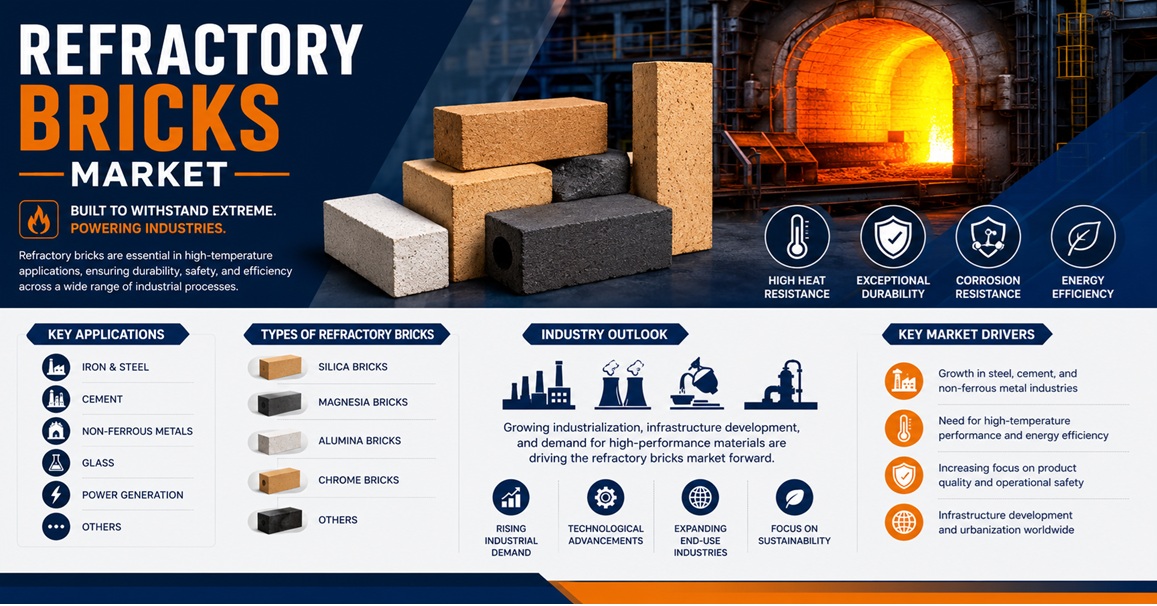
Refractory Bricks Market (2026 - 2035)
North America's refractory bricks market is growing at a 3.82% CAGR, supported by reshoring-driven furnace construction in the US and Mexico.
NJ, UNITED STATES, July 22, 2026 /EINPresswire.com/ -- According to a comprehensive report by Market Research Future (MRFR), the global refractory bricks market reached an estimated USD 18,200 million in 2025 and is projected to grow from USD 18,974 million in 2026 to USD 27,595 million by 2035, registering a compound annual growth rate of 4.25%. This expansion is being driven by a global steelmaking renaissance, the emergence of hydrogen-based direct-reduced-iron (DRI) furnaces that demand entirely new brick chemistries, and tightening carbon-border adjustment mechanisms that are compelling end users to specify next-generation lining solutions.The Steel Imperative: Capacity, Conversion, and Chemistry
The single largest driver of the refractory bricks market is the global steel industry's dual challenge: expanding capacity to meet infrastructure demand while decarbonizing production to meet climate commitments. India's crude steel capacity reached approximately 160 million tonnes per annum (MTPA) in 2024, and the National Steel Policy targets 300 MTPA by 2030. For every million tonnes of new blast-furnace capacity, 15,000–18,000 tonnes of refractory lining material is required in the first campaign alone. India's capacity build-out alone represents billions of dollars in refractory brick demand over the forecast period.
But capacity expansion is only half the story. The deeper transformation is the shift from blast furnaces to electric-arc furnaces (EAFs) and hydrogen-based DRI units. EAF linings face more aggressive thermal shock profiles than traditional blast furnaces, favoring magnesia-carbon and high-alumina bricks that command 25–40% price premiums over conventional fireclay formulations. This structural mix shift boosts value growth for the refractory bricks market even where volume growth is moderate.
RHI Magnesita's 2023 annual report highlighted that the company redirected 18% of its R&D budget toward DRI-compatible products, signaling where the industry's center of gravity is shifting. As steelmakers pilot hydrogen-based DRI at scale—SSAB's HYBRIT plant in Sweden and ArcelorMittal's Hamburg facility are early movers—the refractory bricks market faces demand for entirely new brick chemistries that resist hydrogen embrittlement and water-vapor erosion. The International Energy Agency's Net Zero Emissions scenario requires 50% of global steel production to come from near-zero-emission pathways by 2050, meaning a steep acceleration in furnace transitions after 2030. Brick makers who establish verified product lines for hydrogen DRI, molten-oxide electrolysis, and biomass-fired kilns will capture a disproportionate share of the market.
Download Report Sample Copy with TOC: https://www.marketresearchfuture.com/sample_request/23446
Cement and Alternative Fuels: The Kiln Relining Wave
The cement industry is the second major demand pillar. The European Cement Association states that its members aim to increase alternative fuel substitution rates to 60% by 2030. The variable slag chemistry and alkali concentrations in kilns burning refuse-derived and biomass fuels require operators to upgrade from ordinary alumina linings to chrome-magnesia or spinel-bonded compositions. This wave of kiln relining is producing a multi-year procurement cycle across the refractory bricks market.
Cement producers are also upgrading kiln linings to withstand alternative fuel blends—a shift that broadens the addressable base for premium brick suppliers. The cement end-user segment is advancing at a 4.48% CAGR, propelled by a global kiln-upgrade cycle tied to alternative-fuel mandates and capacity expansions in India and Southeast Asia.
Product and Chemistry Dynamics
Clay refractories held a 58.5% share of the refractory bricks market in 2025, reflecting their dominant use in blast furnace and ladle applications. Fireclay, high-alumina, and silica formulations remain the backbone of the market because of their versatility and cost-effectiveness in blast-furnace ironmaking and foundry operations.
Non-clay refractories are forecast to expand at a 4.91% CAGR through 2035, driven by demand from EAF steelmaking and hydrogen-ready DRI units. Magnesia-carbon bricks alone account for the majority of converter and EAF lining installations globally. The pricing gap between clay and non-clay bricks—non-clay formulations typically cost 2–4 times more per tonne—means that even modest share shifts carry outsized revenue implications. Producers investing in high-purity raw-material sourcing and proprietary bonding technologies are best positioned to capture this premium migration.
Silicon carbide is projected to reach a valuation of USD 743 million by 2035, valued for its exceptional thermal conductivity and abrasion resistance in non-ferrous metal smelting and waste-to-energy applications. Zirconia bricks serve the glass industry and specialized high-temperature chemical processes where thermal shock resistance is paramount.
By manufacturing process, extrusion is projected to grow to USD 1,012 million by 2035, favored for producing complex shapes with uniform density. Dry pressing remains the dominant method for standard bricks, while slip casting and injection molding serve specialized applications requiring intricate geometries.
Purchase Now: https://www.marketresearchfuture.com/checkout?currency=one_user-USD&report_id=23446
End-User Industry Landscape
Iron and steel captured 67.0% of the refractory bricks market in 2025, underscoring the sector's outsized consumption intensity. A single integrated steel plant can consume 10–15 kg of refractories per tonne of crude steel produced, and relining cycles every 2–5 years create a steady replacement demand stream. The sector's dominance is structural: steel is the world's most consumed metal, and every stage of its production—from coke ovens through blast furnaces, converters, ladles, tundishes, and continuous casters—requires refractory protection.
Cement is the second most dynamic end-user segment at a 4.48% CAGR, propelled by alternative-fuel kiln conversions and capacity expansions in India and Southeast Asia. Non-ferrous metals are advancing at a 4.15% CAGR, driven by aluminum, copper, and nickel smelting that requires specialized lining chemistries. Glass generated USD 728 million in 2025, serving float-glass and container-glass furnaces where fused-cast AZS (alumina-zirconia-silica) bricks dominate. Energy and chemicals accounted for USD 1,456 million, serving petrochemical crackers and gasifiers. Ceramics and other industries—including waste-to-energy and power generation—round out the demand mosaic.
Regional Dynamics: Asia-Pacific Dominates, All Regions Transform
Asia-Pacific commands roughly 68.0% of the refractory bricks market, anchored by China's steelmaking complex and India's accelerating capacity build-out. The region is also the fastest-growing, expanding at a 4.45% CAGR through 2035. China alone contributes 52.4% of regional share, operating more than 1,000 blast furnaces and thousands of rotary kilns that create an enormous relining cycle. Even during periods of slower capacity growth, the sheer installed base sustains brick demand.
India is the region's standout growth story at a 4.68% CAGR. JSW Steel, Tata Steel, and SAIL collectively plan to add over 80 MTPA by 2030, and each new furnace campaign generates multi-year refractory procurement contracts. Japan contributes USD 1,240 million through high-grade refractories for specialty steel production, while South Korea's automotive and shipbuilding steel sustains 6.8% of regional share. The ASEAN bloc is advancing at a 4.72% CAGR on greenfield industrial build-out.
Europe holds the second-largest share at approximately 14.5%, driven by decarbonization mandates and EAF conversions. Germany anchors regional demand at 28.3% of share through EAF steel conversion and automotive steel demand. The EU's Carbon Border Adjustment Mechanism (CBAM), which entered its transitional phase in October 2023 and moves to full financial compliance by 2026, indirectly raises refractory specification requirements for EU-bound producers. The Nordic region serves as a proving ground for hydrogen-based steelmaking, pulling premium brick orders disproportionate to its output volume. Italy's specialty steel mills and France's cement and glass industries sustain demand across the continent.
North America accounts for around 10.2%, buoyed by reshoring incentives and defense-adjacent metal processing. The United States dominates with 72.5% of regional share, where OSHA's 2024 enforcement guidance tightening permissible silica-dust exposure to 25 µg/m³ is accelerating the adoption of low-silica brick formulations. Canada's refractory consumption tracks its non-ferrous metals complex, particularly nickel smelting in Ontario and aluminum in Quebec. Mexico's automotive-steel corridor in Monterrey is drawing fresh investment from both domestic and Asian steelmakers.
South America is valued at USD 746 million in 2025, with Brazil dominating at 71.3% of regional share through vertically integrated steelmakers such as Gerdau and Usiminas. The Middle East & Africa is advancing at a 4.38% CAGR, with Saudi Arabia's NEOM-linked DRI investments and the UAE's aluminum smelter expansions driving greenfield demand.
Report Summary: https://www.marketresearchfuture.com/reports/refractory-bricks-market-23446
Competitive Landscape
The refractory bricks market exhibits low-to-moderate concentration, with the top five producers collectively holding an estimated 35–42% of revenue share and a Herfindahl-Hirschman Index below 800. The competitive field includes global integrated players with captive raw-material mines, mid-tier regional specialists, and a long tail of local manufacturers—particularly in China and India—competing largely on price. Strategic consolidation has accelerated since 2017, when RHI and Magnesita merged, and further M&A is likely as producers seek raw-material security and geographic diversification.
RHI Magnesita leads with an estimated 12–16% revenue share, distinguished by vertical integration and global scale. The company's redirection of 18% of R&D toward DRI-compatible products signals strategic focus on the decarbonization transition. Vesuvius captures 7–10% through technology-led positioning in steel continuous casting and flow control, posting 12.6% year-over-year revenue growth in Q1 2026. Shinagawa Refractories holds 5–8% as the dominant Japanese producer, with its "Vision 2030" framework breaking ground on a new shaped refractory plant in Setouchi City scheduled for completion in February 2026.
Krosaki Harima accounts for 4–7% through its integrated production and Nippon Steel alliance. Saint-Gobain (SEFPRO) captures 4–6% as the leader in glass-industry refractories, while Morgan Advanced Materials specializes in insulating firebrick and thermal management at 3–5%. HarbisonWalker International is the largest North American producer at 3–5%, and Calderys completed integration with HWI's South American footprint in December 2023, establishing a unified supply hub across Brazil.
Related Report
concrete blocks bricks market https://www.marketresearchfuture.com/reports/concrete-blocks-bricks-market-26296
bricks market https://www.marketresearchfuture.com/reports/bricks-market-25099
pollution absorbing bricks market https://www.marketresearchfuture.com/reports/pollution-absorbing-bricks-market-25783
rubbing bricks market https://www.marketresearchfuture.com/reports/rubbing-bricks-market-40010
black bricks market https://www.marketresearchfuture.com/reports/black-bricks-market-22367
Market Research Future
Market Research Future
+1 855-661-4441
email us here
Legal Disclaimer:
EIN Presswire provides this news content "as is" without warranty of any kind. We do not accept any responsibility or liability for the accuracy, content, images, videos, licenses, completeness, legality, or reliability of the information contained in this article. If you have any complaints or copyright issues related to this article, kindly contact the author above.
